Verba
What is adaptive immersion?
Adaptive immersion is language immersion that adapts to what you know. An adaptive immersion tool tracks the words you’re learning. Then it picks content where those words come up again, in new sentences, at the time you’re due to review them.
Verba is the first adaptive immersion tool. It works with Japanese and Korean YouTube videos.
I’m Ben, and I built Verba. I came up with the name adaptive immersion because I needed one. I found it really hard to explain what Verba does without a word for it.
What problem does adaptive immersion solve?
Adaptive immersion solves one problem: the words you need to learn don’t come back often enough in what you watch.
Immersion works really well for the most common words. A word in the top 1,000 turns up about 7 times in an hour of speech, so you pick it up fast. A word ranked between 3,000 and 4,000 turns up about once in 8 hours. If you immerse for an hour a day, you see that word about once a week. By then you’ve often forgotten it. Why I built Verba has the sources for those numbers.
So immersion right now is brute force. You watch more and more, and hope the words you need turn up.
The usual fix is Anki. Anki makes sure you see a rare word again before you forget it. But you pay for that. The reviews pile up, and one day off turns into a backlog. And each card shows you the word in the same sentence every time, so you end up remembering a specific usage example, not developing proficiency with the word.
So immersion gives you variety, with no guarantee on the timing. Anki gives you the timing, with no variety. Adaptive immersion gives you both in one place.
How is adaptive immersion different from immersion plus Anki?
With immersion plus Anki, you run two things side by side. You immerse, and then you do a separate review session. With adaptive immersion, the review happens inside the immersion. The word you’re due to review is already in the video you’re watching.
| Do rare words come back on time? | Is each review a new sentence? | Is there a separate study session? | |
|---|---|---|---|
| Brute-force immersion | No | Yes | No |
| Immersion plus Anki | Yes | No, the same card every time | Yes |
| Adaptive immersion | Yes, if the library has a video with that word | Yes | No |
What is optimized input?
Optimized input is content that contains the words you need to see, when you need to see them. It’s what an adaptive immersion tool gives you.
The language learning community has spent years optimizing flashcards. No meaningful progress has been made on optimizing the input itself. That’s the gap adaptive immersion fills.
What is optimized input? covers the research on how we learn language that this idea comes from.
What is the context algorithm?
The context algorithm is the part of Verba that picks your videos. It’s how Verba optimizes your input.
The context algorithm checks each video for two things:
- how many words it contains that you’re due to review
- how many words it contains that you’ve seen before
Then the context algorithm recommends the videos that contain the most of them.
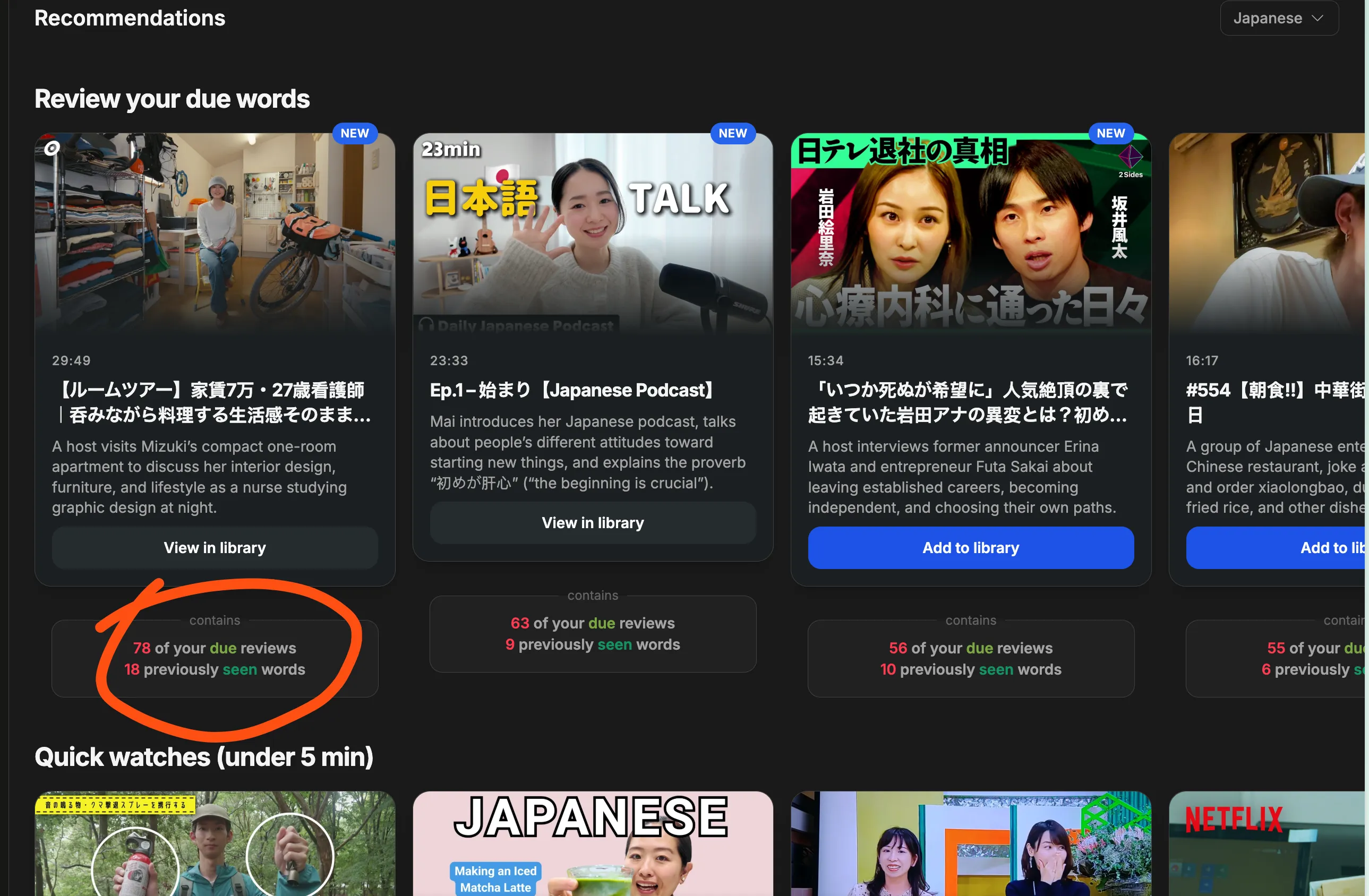
What does adaptive immersion look like in Verba?
In Verba, adaptive immersion is three steps.
1. You pick a recommended video. Each one shows how many of your due words and seen words it contains.
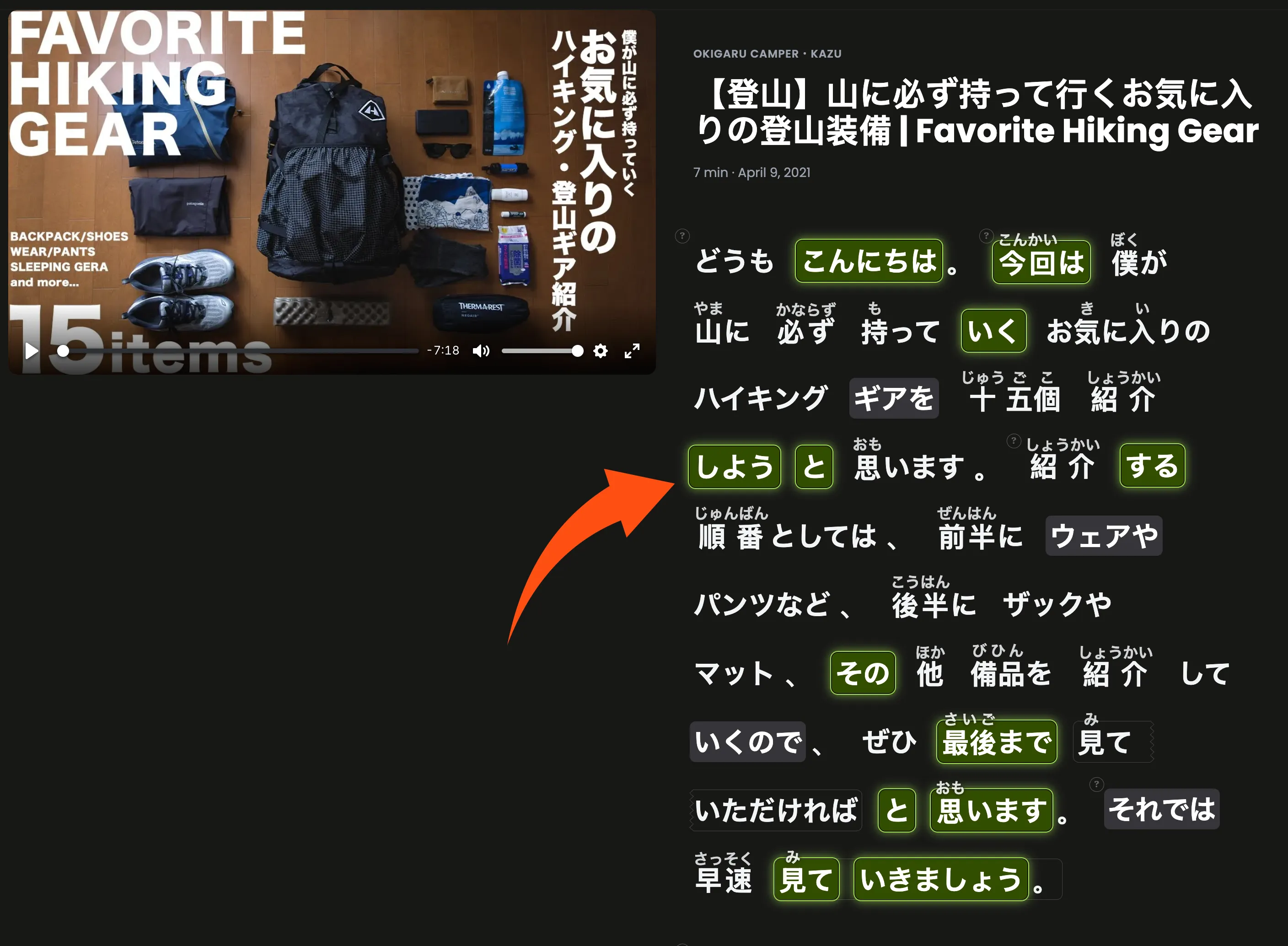
2. You watch it. The words that are due for review are highlighted in the transcript.
3. You click a due word. The flashcard asks you what the word means in that sentence. It’s a sentence you haven’t seen before, so you can’t answer from your memory of a card. You use the sentence to work out the meaning. The word is often conjugated differently each time too, so you’re not just learning one form of it.
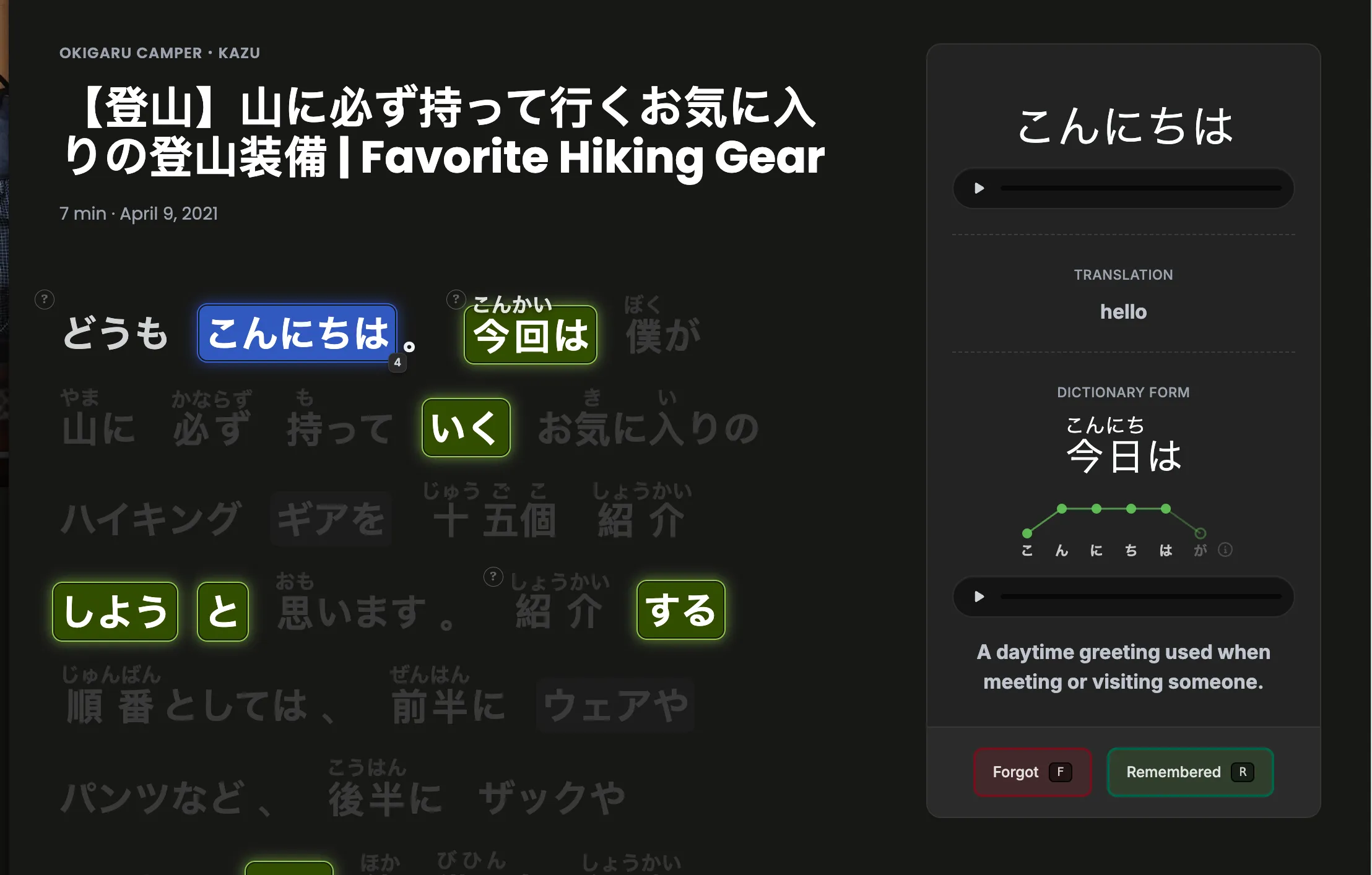
If you don’t like flashcards, you can turn them off. Verba then just asks you to review the word when you click it.
What can’t adaptive immersion do yet?
Right now, adaptive immersion in Verba has three limits.
- The library. The context algorithm picks from Verba’s own growing library of YouTube videos. So a rare word doesn’t always have a video yet.
- Your interests. The context algorithm doesn’t know what you like to watch just yet. It picks on your words, not on your taste.
- Proof. I haven’t shown with data that adaptive immersion gets you to fluency faster than immersion plus Anki. That’s the hypothesis Verba is built on. I want to show hard evidence for it, and that needs a lot more data than a new product has.
Who is adaptive immersion for?
Adaptive immersion is for people who already learn Japanese or Korean through immersion, and are tired of the Anki backlog. You like the idea of learning from real content. You don’t like the review sessions that come with it.
Adaptive immersion is not a course. There are no lessons, and nobody explains grammar to you step by step. If that’s what you want, Verba is the wrong tool.